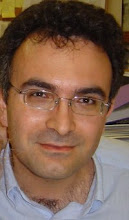
Here's my story:
I started blogging because of a need I felt to express myself on the current state of affairs in Greece and - through a lens focused on that context - in Europe.
There is one thing which is currently more than clear to me, and many others, I believe. At the end of the first decade of the 21st century, in Greece we have reached an end. That is the end of what we have for decades taken for granted, what we have accepted, and, ironically, at the same time reproached and reinforced; that is the end of the systematised, typical compound of political and public life modes in this country.
Greece has been standing in crossroads for quite some time now - it may have always been a crossroad itself, literally and metaphorically (but that's a long story, as long as a discussion on the Greek psyche could be).
The ground on which these crossroads are found is not level ground - it never was.
In recent years (but not for the first time in history) Greek practice has helped this ground incline further to become dangerously slippery. In a skew world context, our systemic defences have weakened; imported trembles are becoming major earthquakes shaking our domestic foundations.
My aim is not to draw another gloomy sketch of the crisis.
What I hope I can offer to my co-citizens (in Greece, and everywhere), is some thought on how we could make our public spheres again decently inhabitable.
My chosen terms of reference are Ancient Greek, therefore global (still). And so my proposition:
Yes, we can (and must):
- with Paideia (learning, education) as our vehicle
- empowered by Demokratia (democracy)
- with Gnosis (knowledge) and Politike Arete (civic excellence) as our reference concepts and qualitative criteria of every-day Praksis (action).
Ich kann, weil ich will, was ich muss.
Immanuel Kant